

Tire rubber particle cracking device


Working Principle:
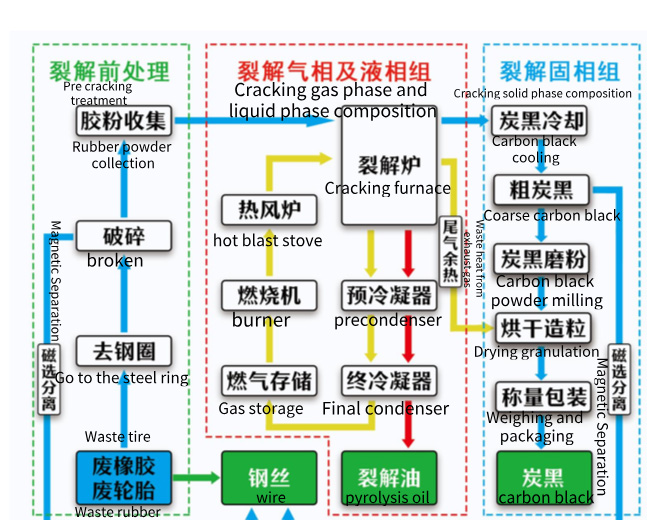
The tire rubber pyrolysis device primarily converts waste tires into gaseous, liquid, and solid products through a high-temperature pyrolysis process.
Process Description
1. Use nitrogen gas for full blowing and replacement. After the blowing is completed, use natural gas as fuel to start the burner and hot air furnace. When the temperature control point t1 of the cracking furnace reaches 470 ℃, start feeding.
2. The rubber powder is fed into the material trough through a screw conveyor, and then fed into the cracking furnace through a feeder. The feeder adopts material sealing and other methods to prevent air from entering the subsequent system, achieving safe and sealed production.
3. Inside the pyrolysis furnace, rubber particles pyrolyze when heated. The cracking furnace has three layers of cracking chambers, which provide forward power for the rubber particles through screw transportation and transport them from the upper layer to the lower layer by gravity.
Solid product: Carbon black is discharged from the slag discharge port at the tail end of the third layer cracking chamber and transported to the subsequent process through a water-cooled screw conveyor;
Liquid product: The cracking furnace is equipped with two oil and gas outlets, and the oil and gas enter the oil and gas separation tank for natural cooling. The naturally condensed cracking oil is collected into the heavy oil tank, and the oil and gas mixture is further separated by the condenser. The generated cracking oil is stored in the temporary storage tank at the bottom of the condenser and transported to the oil storage tank through an oil pump; The excess non condensable gas also turns into oil after freezing.
Gaseous products: The cracking non condensable gas produced by the condenser is transported by a vacuum pump to the cracking gas buffer tank, pressurized by a booster pump, and then transported to a hot blast furnace for combustion. The burned exhaust gas is treated and discharged to meet the standard.
The advantages of our internal rotary cracking furnace
1. Sealed well and without coking
Compared with the external rotary cracking furnace, the internal rotary furnace requires a smaller sealing area, a shorter and more stable spiral length in each section of the three-layer furnace body structure, and a better sealing effect. Our furnace body material 310S is austenitic chromium nickel stainless steel, which can withstand high temperatures of 1200℃ (normal use 700℃), has excellent corrosion resistance and tensile strength, and can prevent scaling. The structural and material advantages enable our cracking furnace to avoid the common coking phenomenon in external rotary cracking furnaces.
2. Self cleaning, no blockage
An online carbon ash removal device is installed at the connection between the cracking furnace and the oil and gas separation tank to prevent a small amount of carbon ash carried by oil and gas from entering the cooling system and solve the problem of oil and gas pipeline blockage. This device has two sets of devices: ash removal and ash cleaning. Ash removal involves continuously scraping off the carbon ash on the pipe wall, while ash cleaning involves intermittently transporting the scraped carbon ash to the cracking furnace for further cracking. The process is controlled by the central control system, which keeps the pipeline clean and does not produce waste residue.
Comparison between rotary cracking furnace and multi-stage internal rotary cracking furnace
| Serial number | Project category | Rotary thermal cracking furnace | Molten salt multi-stage spiral pyrolysis furnace |
| 1 | Heating medium | Hot blast stove | molten salt furnace |
| 2 | Heat transfer temperature difference | 200-300℃ | 10℃ |
| 3 | Temperature control | It is difficult to control the temperature precisely | Precise temperature control |
| 4 | Pyrolysis product | oil———40% Non-condensable—12% Carbon black——34% Steel wire——12% | oil———45% Non-condensable—9% Carbon black——34% Steel wire——12% |
| 5 | Sealing of the cracking device | There is a gap between the dynamic and static equipment and the seal is not tight | Multi-stage material seals ensure tight sealing of static equipment |
| 6 | Single-line processing scale | 10,000 tons per year | 10,000 tons per year |
| 7 | Size of cracking equipment | The equipment occupies a large area and is about 22 meters long | The equipment occupies a relatively small area and is about 9 meters long |
| 8 | Continuous running time | After 45 to 50 days, the furnace needs to be shut down for inspection and replacement of the mechanical seal, as well as for coke cleaning of the furnace body | It should operate continuously and stably for 2 to 3 months and undergo normal planned maintenance |
| 9 | Operation and maintenance | Complex, slow start-up and shutdown of the furnace, and large maintenance volume | Simple, quick start-up and shutdown of the furnace, and low maintenance |
| 10 | Price of cracking unit | The consumption of steel is large and the price is high | Low price |
Scope of application: Suitable for processing waste tires, waste rubber, and waste plastics